
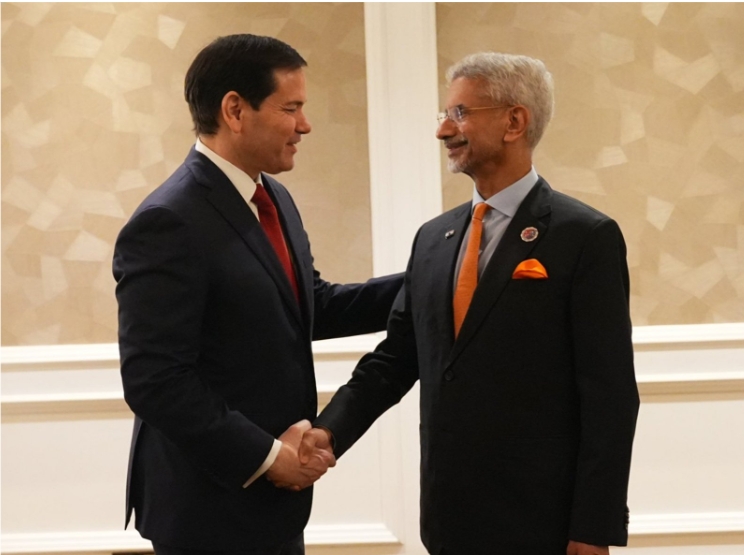
Today, Indian External Affairs Minister Dr. S. Jaishankar will meet with U.S. Secretary of State Marco Rubio in Washington, D.C. The meeting comes one day before Minister Dr. S. Jaishankar represents India in a U.S.-hosted Critical Minerals Ministerial meeting with over 50 nations to strengthen and diversify critical mineral supply chains. It also occurs only one day after a new U.S.-India trade agreement was announced in which the United States agreed to lower its reciprocal tariffs on Indian imports to 18%, and India agreed to reduce trade barriers and tariffs on the United States and invest in core U.S. industries. On Monday, President Trump also announced that India had agreed to stop buying Russian oil. While the new trade deal will be one highlight of the meeting, the officials are also expected to discuss Pax Silica, a U.S.-led framework for secure AI, critical technology, and semiconductor supply chains, which India is expected to join over the coming weeks. The framework currently includes the United Kingdom, Israel, Japan, South Korea, Singapore, Australia, Greece, Qatar, and the UAE, alongside non-signatory participants Canada, the European Union, the OECD, and Taiwan.
Why it matters
- The tariff deal is more than an economic reset. It signals a strategic recalibration of the U.S.–India relationship toward deeper integration of economic, technology, and security interests, removing bilateral tension that could open the door for continued cooperation on the India Middle East Europe Economic Corridor and other strategic priorities.
- At the same time, Pax Silica represents a broader architecture for U.S. partners to cooperate on all elements of the artificial intelligence supply chain, from advanced computing and semiconductors to AI infrastructure and critical minerals. India hosting an AI summit this month and its likely entry into Pax Silica underscores the growing importance of global technology cooperation, especially with Middle East countries and U.S. aligned partners, in its calculus when deciding geopolitical alliances.
- If India has agreed to stop purchasing Russian oil as part of the deal, a departure from recent practice, that could strain a critical funding source for Moscow as the United States seeks to advance negotiations between Ukraine and Russia to end the war.
Insight from N7 Experts
Gershom Sacks: “India has made two big moves in recent weeks - trade deals with the United States and the European Union. Both deals are milestones. The deal with the United States removes a key bilateral irritant that could help refocus the U.S.-India relationship on strategic priorities from security to AI. The deal with the European Union removes barriers to trade and investment. Building off bilateral economic agreements India enjoys with Israel and the United Arab Emirates, both could ultimately have tangible downstream impacts on connectivity and security cooperation, from Pax Silica to the India-Middle East-Europe Economic Corridor.”
Emily Milliken: “India’s evolving posture is part of a larger shift from geopolitical partnerships being dependent on military and diplomatic ties to being cemented around emerging technology and economic interoperability. Pax Silica, with India approaching membership, is part of this emerging architecture — one that now also shapes how U.S. allies in the Gulf pursue AI, digital infrastructure, and strategic autonomy.”
Joseph Epstein: “The linkage of tariff relief to India curbing Russian oil purchases underscores how energy geopolitics can shape trade agendas, but it also risks oversimplifying New Delhi’s nuanced balancing act. Nevertheless, a meaningful reduction — or halt — in Indian imports of Russian oil would repreent a significant strategic and economic win for the United States and its allies.”