
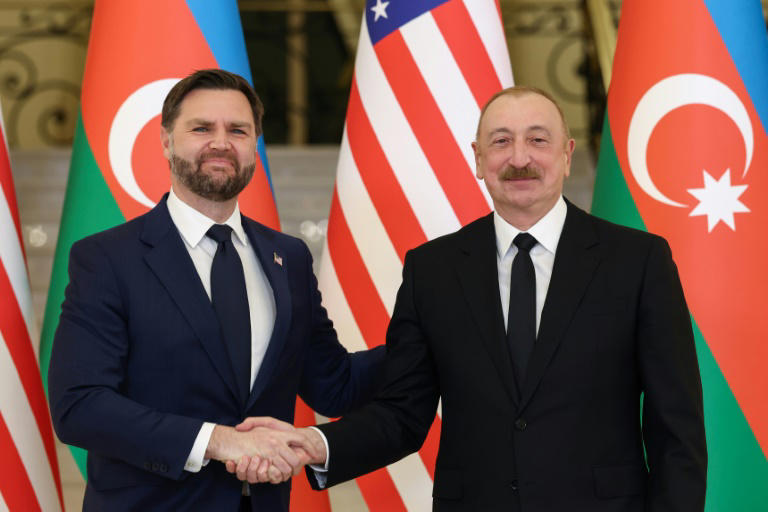
Last week, Vice President JD Vance visited the South Caucasus, offering Armenia and Azerbaijan a series of trade and security deals designed to loosen their dependence on Moscow and shrink the sway of neighboring Iran. Under Secretary for Economic Affairs Jacob Helberg joined Vance throughout the trip, underscoring the economic and connectivity dimensions of the visit. The two-country tour was the first time a sitting U.S. vice president had ever visited Armenia and the first visit of a vice president to Azerbaijan since 2008. Together, the visits sent an unambiguous signal about Washington’s commitment to reshaping trade and security architecture in a region long dominated by Russia.
Why it matters
In Armenia, Vance and Prime Minister Nikol Pashinyan signed an agreement to advance negotiations on a civil nuclear energy deal, in line with the administration’s broader strategy of using energy cooperation as a gateway to deeper strategic alignment. Vance also announced that the U.S. was ready to export advanced computer chips and surveillance drones to Armenia and invest in the country’s infrastructure.
In Azerbaijan, Vance signed a Strategic Partnership Charter with President Ilham Aliyev covering regional connectivity, economic investment, and security cooperation, with a particular focus on the Trump Route for International Peace and Prosperity (TRIPP) — a road-and-rail corridor designed to connect Azerbaijan’s Nakhchivan exclave through Armenian territory and onward to Turkey, integrating the region into a broader east-west trade route linking Central Asia and the Caspian basin to Europe.
The visit carries direct implications for Iran. If TRIPP comes to fruition, the route would cost Tehran critical transit revenues and diminish one of its key geopolitical levers over Azerbaijan. The trip also advanced the administration’s critical minerals agenda. On February 4, Vance unveiled plans to marshal U.S. partners into a preferential trade bloc for critical minerals, and Armenia and Azerbaijan’s integration into that framework aligns with broader U.S. goals of securing access to Eurasian strategic resources.
Insight from N7 Experts
Gershom Sacks: “Washington is shoring up its strategic position in the south Caucasus as Moscow remains mired in its war in Ukraine and Tehran is in disarray. The visit highlights the strategic importance of the south Caucasus and efforts to build on the Armenia-Azerbaijan peace deal with the TRIPP, which could become a key artery for rare earth supply chains.”
Emily Milliken: “Under Secretary Helberg’s inclusion on the trip demonstrates that the U.S. views the South Caucasus through the same technology and economic lens it is applying across its alliances. Critical minerals, AI infrastructure, and civil nuclear cooperation are becoming the connective tissue of U.S. partnerships from the Caucasus to the Gulf.”
Joseph Epstein: “TRIPP didn’t emerge from a vacuum — it became possible because the geopolitical architecture Russia spent thirty years constructing has begun to collapse. The contrast is stark: three decades of Russian-led mediation produced no peace, only managed hostility and isolation. Less than a year of serious U.S. engagement has produced a Strategic Partnership Charter, a civil nuclear framework, and the contours of a transformative regional corridor. TRIPP is the architecture of a post-Russian South Caucasus and this visit shows how much of a priority it is for Washington.”