

Few Central Asia observers were surprised by the recent and unanimous decision to include Azerbaijan as a full-fledged member in the Consultative Format of Central Asian nations, given its longstanding role in fostering regional connectivity and energy cooperation. The forum—originally composed of Kazakhstan, Uzbekistan, Kyrgyzstan, Turkmenistan, and Tajikistan—is a platform for cooperation among Central Asian states. Baku’s accession to the format signals both Central Asia and Azerbaijan want to be seen as part of a single region.
Building on that expansion, the United States should now add Azerbaijan to the C5+1 format and consider inviting Israel to join the framework, creating a C6+2. Incorporating Israel would provide Washington with the expertise of a trusted partner that maintains diplomatic, economic, and security relationships across the region. Coordinated engagement would enhance the ability of the United States and Israel to shape outcomes and expand their influence—particularly as they compete with entrenched powers such as Russia and China that remain broadly opposed to U.S. involvement in the region.
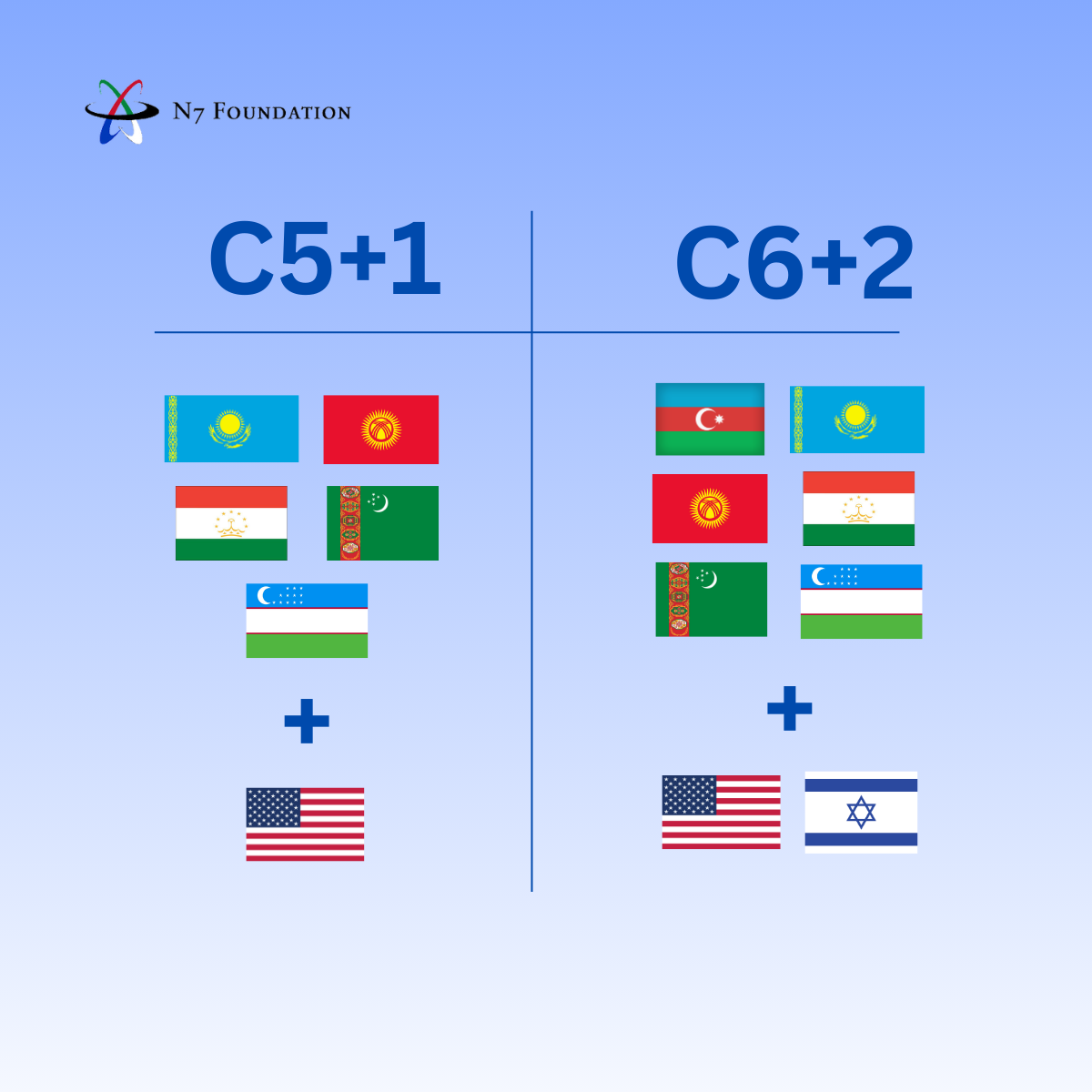
An Israeli role will also help secure U.S. strategic interests. Namely, by supporting the Trans-Caspian International Trade Route or Middle Corridor, a trade route through Central Asia and Azerbaijan to Europe bypassing both Russia and Iran as well as helping develop critical mineral processing abilities. Jerusalem could also support the region in strategic initiatives such as water management and cybersecurity.
Azerbaijan as a Bridge Between Central Asia and the West
Although Azerbaijan is not formally part of Central Asia, it arguably maintains deeper practical cooperation with individual Central Asian states than many of those states maintain with one another. Since reclaiming control over most of the Karabakh region in 2020 and then all of it in 2023, Baku has made promoting regional integration and strengthening connectivity between Central Asia and the West one of its core strategic priorities. Azerbaijan has advanced this objective in part through the Organization of Turkic States (OTS)—whose members include Turkey, Azerbaijan, Kazakhstan, Uzbekistan, and Kyrgyzstan, with Hungary and Turkmenistan participating as observers. At the most recent OTS summit in Qabala, Azerbaijan, President Ilham Aliyev emphasized the importance of unity, stating that “it is very important for the Turkic states to act as a single power center.” Baku’s willingness to assert its interests independently of Moscow—including during the 2024 incident in which a Russian aircraft downed an Azerbaijani civilian plane, leading to a months-long diplomatic rift and a subsequent personal apology from President Vladimir Putin—further strengthened its standing across the region.
Azerbaijan has simultaneously prioritized improving relations with the United States. Since President Donald Trump took office, Aliyev has sought to expand cooperation with Washington, including trilateral initiatives with Israel, efforts to reposition the United States as a mediator in the peace process with Armenia leading to talks in Washington leading to the August 8th peace summit, and alignment with U.S. regional goals in the Middle East such as reconstruction efforts in Syria, mediation between Turkey and Israel, and consideration of participation in multinational stabilization forces in Gaza. These steps have generated political goodwill, with Trump publicly praising Aliyev on multiple occasions.
Another key benefit that Azerbaijan offers is connectivity. As a landlocked region, Central Asia relies on its neighbors to access the Global Ocean for trade purposes. While this has traditionally meant the region had to rely on Russia and China, as the Middle Corridor has grown over the years, an alternative route through the Caspian Sea and Azerbaijan has emerged. Such alternatives are crucial for Central Asia’s “multi-vectoral” policy of balancing relations to avoid overreliance on any one nation.
For both Central Asian and the United States, Azerbaijan’s inclusion in the C5+1 framework offers a pragmatic bridge for deeper engagement. Unlike other regional players—whose ideological and geopolitical ambitions can complicate coordination—Baku’s pragmatic diplomatic approach allows it to communicate effectively with both Washington and the Central Asian states.
However, relying solely on the OTS as a mechanism for regional cooperation presents limitations, most notably the exclusion of Tajikistan. While Dushanbe’s role in regional security is often underestimated, sustained engagement and support from regional and international partners is critical for regional security. Many Central Asian recruits involved in extremist networks, including the Islamic State Khorasan Province (ISIS-K) and Iranian-linked destabilization efforts, have been Tajik nationals. Recent high-profile attacks such as the Crocus City Hall massacre in Moscow that killed 149, the Kerman bombings in Iran that killed at least 95, and IRGC-linked planned attacks on Jewish sites in Kazakhstan and Uzbekistan in the wake of October 7th have been attributed to Tajik militants.
The Case for Israeli Inclusion
Just as the Central Asian states and Azerbaijan have increased their bargaining power and streamlined cooperation through regional frameworks, the United States should establish a parallel mechanism for its partners to align efforts in Central Asia. Israel would be a logical first addition, given its long-standing relationships in the region Jerusalem was among the first countries to recognize the independence of the newly sovereign Central Asian republics following the collapse of the Soviet Union in 1991, and since then it has cultivated strong relations with key regional players, especially Azerbaijan, Kazakhstan, and Uzbekistan.
Azerbaijan has benefited most visibly from this partnership. Israel provided Baku with advanced defense technologies that proved decisive in its victory over Armenia in the 2020 war, and the two states cooperate closely against Iran, which both view as a major strategic threat. Diplomatically, Israel—and the broader pro-Israel community in the United States—have played an important role in strengthening ties between Washington and Baku. Many credit this network with securing annual waivers to Section 907 of the 1992 Freedom Support Act, which restricts U.S. aid to Azerbaijan over the conflict with Armenia. More recently, the office of Israeli Prime Minister Benjamin Netanyahu announced plans to pursue trilateral cooperation with the United States and Azerbaijan, contributing to the significant improvement in U.S.–Azerbaijani relations over the past year.
This cooperation has been made possible in part by Azerbaijan’s long history of positive relations with its Jewish community, which has lived there for more than a millennium and has been regarded as an integral part of the nation. Central Asian states share a similar tradition of coexistence and secular governance, as well as a strong commitment to countering extremism—an important foundation for potential collaboration with Israel.
Just as Israel’s partnership with Azerbaijan supported one of Baku’s central strategic objectives—the restoration of control over Karabakh—it could also support Central Asia in addressing several urgent challenges, including water scarcity, counter-extremism, and cybersecurity.
Addressing Water Scarcity as a Strategic Priority
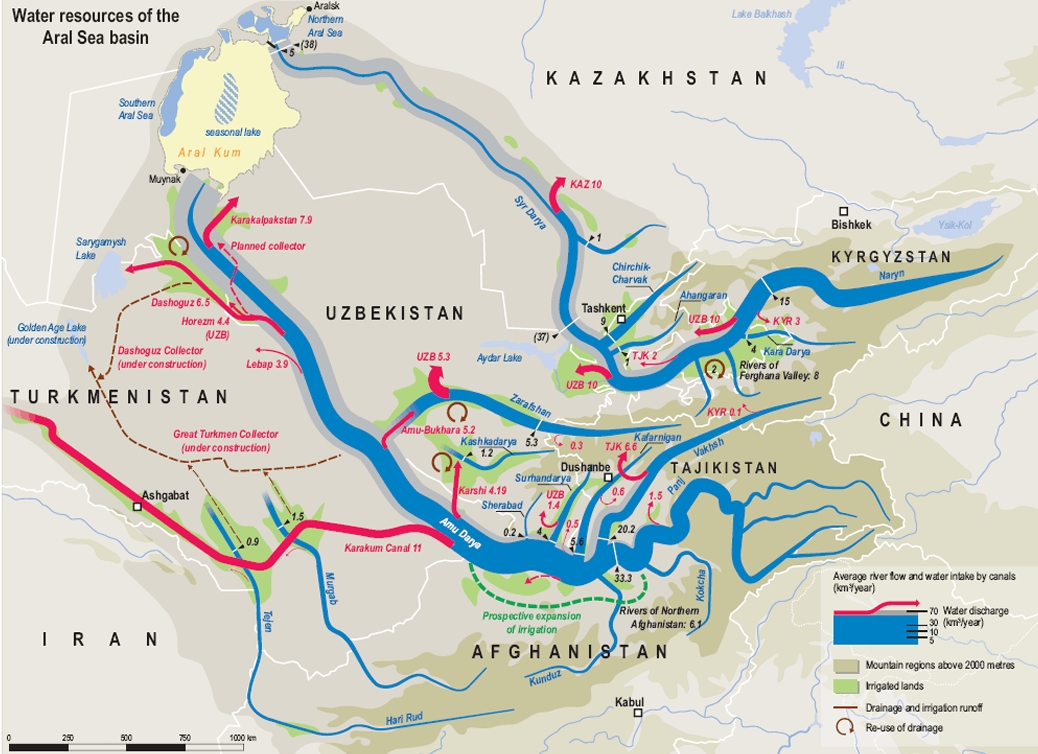
(Source: CA Water Info, ”Water Flow and Water Use Data,” http://www.cawater-info.net/aral/i/vod-res-bam-e.gif)
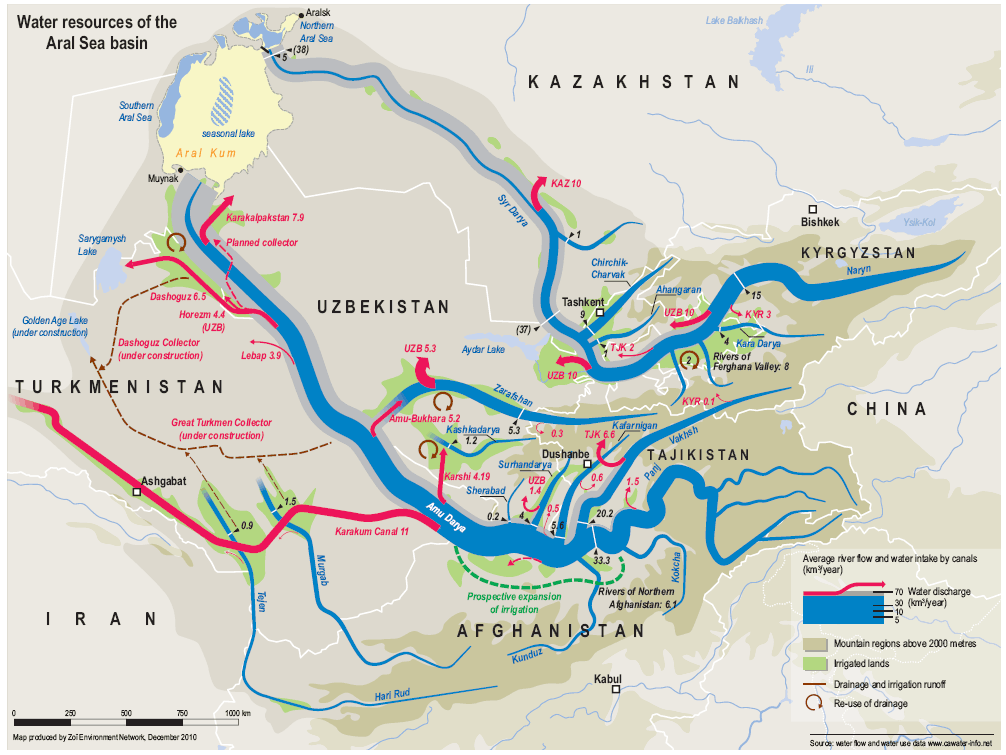
As a recognized global leader in water technology, Israel could leverage its expertise to support Central Asian states who are facing what experts describe as a “perfect storm” of poor water management, over-allocation for agriculture, and climate change.
Water scarcity is not only a humanitarian and agricultural threat; it also directly affects U.S. strategic goals in the region. Washington views Central Asia as a critical partner in efforts to diversify global supply chains for critical minerals, including rare earth elements currently dominated by China. Yet for Central Asia to play this role, it must develop domestic refining and processing capacity, which requires enormous volumes of water. For example, processing one ton of tungsten—a critical mineral that U.S. company Cove Capital recently launched a joint venture to mine in Kazakhstan—requires four to seven tons of water, according to research from Central South University in China. Without sufficient water, these operations will depend on Chinese processing, undermining U.S. strategic objectives.
The same challenge applies to digital infrastructure. Kazakhstan and Uzbekistan are positioning themselves as emerging regional technology hubs. Kazakhstan’s Ministry of Digital Development has launched the International AI Center (alem.ai) and, according to the Amsterdam-based firm Dealroom, now hosts the world’s fastest-growing tech ecosystem, which has expanded eighteen-fold since 2019 to reach $26 billion. Uzbekistan’s IT Park supports thousands of startups and has attracted Russian, Ukrainian, and Belarusian specialists since 2022 through incentives such as tax-free zones for AI and data centers. Yet data processing consumes massive quantities of water: the International Energy Agency estimates that a single 100-megawatt data center can require roughly 2 million liters of water per day, most of which is evaporated through cooling. Some experts estimate that data centers usually evaporate about 80% of the water they draw, discharging 20% back to a treatment facility. This is in comparison to residential water usage, which loses only 10% to evaporation.
Israeli expertise in water management could play a crucial role in addressing these challenges as it has throughout the world. Solutions include:
- Micro- and drip-irrigation systems, which dramatically reduce agricultural water waste while increasing yields;
- Advanced wastewater treatment, enabling large-scale water recycling;
- Smart water network technology, using IoT and AI to reduce leakage, optimize allocation, and modernize aging systems;
- Desalination and brackish water treatment, potentially transformative for Kazakhstan and Turkmenistan.
Strengthening Cyber Resilience in Central Asia
As Central Asian states pursue rapid digital transformation—expanding e-government services, developing IT infrastructure, and increasing online public and private activity—their digital “attack surface” is growing significantly. Institutional capacity, however, has struggled to keep pace. According to the Central Asia Cybersecurity Baseline Study, most states still lack mature legal frameworks, fully developed Computer Emergency Response Teams (CERTs), and comprehensive cyber risk management systems. Both the United States and Israel possess world-leading cybersecurity capabilities and extensive experience countering sophisticated state-backed threats.
Cyber incidents in the region are escalating at an alarming rate. In Kazakhstan, the number of cyberattacks in early 2025 doubled to 30,000 compared to the same period the previous year. Uzbekistan has experienced more than a 6,700 percent increase in cybercrime over the past five years. Tajikistan has the highest rate of cyber threat exposure of any former Soviet republic, with more than 60 percent of users encountering malicious activity.
State-backed cyber operations add another layer of complexity. In February 2025, the Russian-linked hacker group Cozy Bear targeted Azerbaijani media outlets amid the diplomatic rift over the downed Azerbaijani civilian aircraft. In 2024, operatives reportedly tied to Russia’s GRU distributed malware-laden documents targeting Kazakhstan’s government, while the state-sponsored group Fancy Bear deployed custom tools—including the HatVibe loader and CherrySpy backdoor—against targets in Tajikistan, Turkmenistan, Kyrgyzstan, and Kazakhstan.
Cybersecurity is central to U.S. strategic interests in the region. As industries such as mining and logistics become increasingly automated, they also become more vulnerable to targeted attacks designed to disrupt critical supply chains and erode economic resilience.
The Gulf has benefited greatly from Israeli cybersecurity technology, especially since the signing of the Abraham Accords. Likewise, U.S.–Israeli initiatives could help Central Asian states strengthen their defenses through:
- Advanced monitoring, intrusion detection, and threat simulation to protect critical infrastructure;
- AI-driven anomaly detection, encryption, and cloud security tools to safeguard data and emerging AI and data-center hubs;
- Dark-web monitoring and early-warning intelligence systems to identify and neutralize threats before they escalate.
Leveraging these capabilities within the C6+2 framework would help build regional cyber resilience while reinforcing strategic cooperation among Washington, its allies, and Central Asia.
Partnering to Balance Russian and Chinese Influence
While the United States seeks to expand its role in Central Asia, it should not assume that it can—or should—attempt to displace Russia or China as both countries remain deeply entrenched across trade, security, and infrastructure. Their geographic connection to the region as well as their position as the regions largest economic partners, means that the relationships are unlikely to change absent a dramatic geopolitical shift. Instead, Washington should pragmatically pursuestrategic competition—helping Central Asian states reduce overreliance on any single external power and diversify their partnerships.
A growing number of U.S. allies are actively seeking greater economic and political influence in the region, including Saudi Arabia, the United Arab Emirates, Turkey, and major European Union members such as Germany and France. Coordinated engagement among these partners would significantly strengthen Washington’s collective leverage. While the United States acting alone may struggle to counterbalance Russia and China, a coalition of aligned states would carry far greater bargaining power. The proposed C6+2—initially including Israel—could serve as the foundation for such coordination, with the potential for additional states to join over time. The Abraham Accords platform could provide a useful forum for organizing this broader cooperation, particularly if other Central Asian members consider following Kazakhstan’s example in joining.
For the region itself, deeper engagement with the United States and its partners would be welcomed. Central Asian foreign policy is shaped fundamentally by a desire to avoid becoming dependent on the great powers that surround it. A stronger U.S. presence would expand diplomatic and economic options, while also encouraging Russia, China, and others to take regional interests more seriously in their negotiations.
From Vision to Implementation
Forming a framework will mean little without concrete action. The United States should take the following steps to deepen mutually beneficial engagement with Central Asia:
- Build processing capabilities for critical minerals:
A major driver of renewed U.S. interest in the region has been the search for alternative sources of critical minerals. China currently dominates global supply chains and has leveraged this position twice this year to pressure Washington. While many countries hold significant reserves, Central Asia stands out as an attractive alternative: it possesses legacy mining infrastructure dating back to the Soviet era; it hosts substantial deposits—Kazakhstan alone may have the world’s third-largest reserves of rare earth elements; and regional governments are willing to undertake the energy-intensive and environmentally controversial processing stages that many Western states avoid due to regulatory and political constraints.
However, processing remains the central obstacle as the region currently lacks commercial-scale REE separation and refining facilities. Consequently, Central Asia remains dependent on Chinese processing plants, meaning that even if extraction expands, supply chains would continue to run through China and would therefore not materially reduce Beijing’s dominance. Establishing U.S.–Central Asian joint ventures to develop domestic processing capacity would provide Washington with a secure supply of critical minerals while advancing regional economic development.
The United States should also encourage efforts to harmonize regulatory frameworks and investment procedures. Encouragingly, there are signs of growing coordination. As analysts Sobir Kurbanov and Eldaniz Gusseinov of the Kazakhstan-based Nightingale Intelligence observe, “Central Asia is behaving much more like a unified region today than at any point since gaining independence.”
- Streamline economic integration and investment frameworks:
To further support streamlining efforts, Kurbanov and Gusseinov proposed the establishment of a regional implementation hub modeled on the ASEAN Secretariat in Jakarta, which monitors compliance, harmonizes standards, coordinates ministerial councils, and evaluates progress. With regional states recently committing to a $20 billion mutual trade target, such a body would be critical to fulfilling those commitments.
Beyond facilitating intraregional trade, a unified mechanism would help Central Asia attract external investment as a bloc, improving opportunities for U.S. businesses by simplifying standards, aligning logistics and transport rules, and making cross-border industrial projects more feasible.
For such an institution to succeed, it must remain streamlined and efficient. As Tajikistan’s President Emomali Rahmon has noted, the region is already saturated with overlapping organizations claiming to promote integration. A new body must therefore be small, practical, and results-oriented—designed to facilitate cooperation rather than burden governments with additional bureaucracy.
- Expand infrastructure along Middle Corridor:
Supporting the development of the Middle Corridor is essential to ensure that regional supply chains do not remain dependent on transit routes through Russia or China. Although the corridor has seen exponential growth—freight volumes have increased more than sixfold over the past five years and are projected to triple again by 2030—it still faces structural obstacles. Transporting a 40-foot container via the route currently costs an estimated $3,500–$4,500, compared to approximately $2,800–$3,200 through Russia. These higher fees reflect the corridor’s multimodal nature, including ferry crossings across the Caspian Sea, as well as challenges such as significant imbalances in east-west versus west-east cargo flows. Persistent regulatory, customs, and procedural inconsistencies among the countries along the route also create delays and add costs.
Despite these hurdles, the Middle Corridor remains the most viable path for Western access to Central Asia that does not rely on routes controlled by Moscow or Tehran—an increasingly important consideration given recent geopolitical disruptions. Helping drive down costs will therefore be vital.
- Remove legal obstacles impeding cooperation:
Domestically, Washington must also address self-imposed political and legal barriers that undermine its economic engagement. Two long-outdated statutes are particularly problematic. The Jackson–Vanik Amendment—a Cold War-era restriction aimed at the Soviet Union for not allowing Jewish emigration—still formally applies to several Central Asian states, preventing them from receiving permanent normal trade relations (PNTR) status. Similarly, Section 907 of the 1992 Freedom Support Act bars direct U.S. assistance to the government of Azerbaijan, even though Baku and Yerevan have formally committed to a peace process. While the executive branch has issued annual waivers to allow limited security cooperation, the recurring requirement injects uncertainty and discourages long-term planning.
Regional governments view the continued application of these measures as a litmus test of Washington’s seriousness. Removing or updating such legacy restrictions would send a powerful signal that the United States intends to treat Central Asia—and Azerbaijan—with the same level of strategic importance that its rhetoric suggests.
A Unified Strategy
The foundation of effective engagement with Central Asia should be built around regional blocs. In 2024 and 2025, both Kazakhstan’s President Kassym-Jomart Tokayev and Uzbekistan’s President Shavkat Mirziyoyev penned articles outlining their vision of the future of the region. A central theme in both was the need for deeper regional integration. Approaching Central Asia as a unified framework—not a collection of isolated bilateral relationships—will be critical to unlocking its full economic and strategic potential. It will also ensure that smaller states such as Tajikistan and Kyrgyzstan are not marginalized as larger neighbors accelerate cooperation.
The same logic applies to the United States. Just as regional unity strengthens Central Asia’s bargaining power, coordinated engagement among U.S. partners strengthens Washington’s position. Expanding the C6+1 to include Israel would allow the United States and Israel to align strategies, pool expertise, and reinforce one another’s diplomatic and security efforts—ultimately increasing Western influence in a region where competition is intensifying. If Washington aims to shape the future of Central Asia, the time to act, and to act collaboratively, is now.