
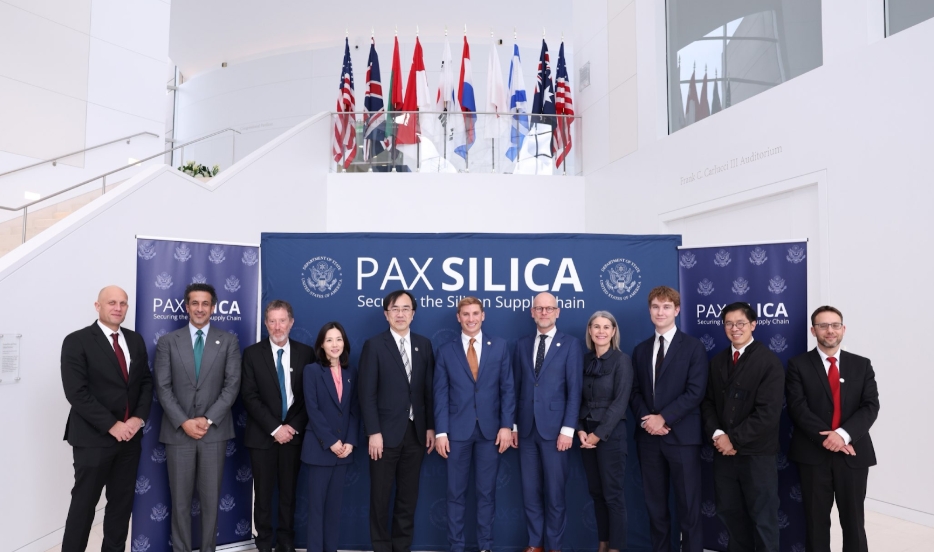
Pax Silica Summit 2025
As 2026 begins, the geopolitical landscape of the Middle East remains fraught with tension. Hamas and Hezbollah remain armed, Syria launched an offensive into northeast Syria, Iran is bracing for potential U.S. military action, and friction between Saudi Arabia and the UAE has grown. Despite these pressures, cooperation on artificial intelligence and emerging technology has soared. Rather than sidelined by conflict, as with many pre-October 7 priorities, innovation is growing with the potential to emerge as a new axis of engagement across borders.
This is somewhat unsurprising. As the region has focused on immediate challenges to national security throughout the Gaza war, its leaders recognize that supremacy in artificial intelligence and emerging technology will come to those who move first, have strategic and sustained discipline, and maintain a broad network of trusted partners. The United States, Saudi Arabia, and the UAE have made those moves, with colossal investments in AI and computing power. Israel has also continued to sharpen its talent pipeline, start-up culture, and future AI plans during the war. The rest of the region is taking steps to ensure they are not left behind.
The United States, building on its tech diplomacy and technological prowess with advanced NVIDIA chips, as well as OpenAI, Google, Microsoft, Meta, and Anthropic’s advanced AI platforms, has cemented deep technological partnerships with Saudi Arabia and the UAE who are eager to be leading players, particularly as the possibility of peak oil in coming decades looms large. Washington also continues to build on partnerships with Israel, launching a strategic partnership on artificial intelligence, research, and critical technologies on January 16, and is thinking long-term about how to win the AI race through investment and partnerships.
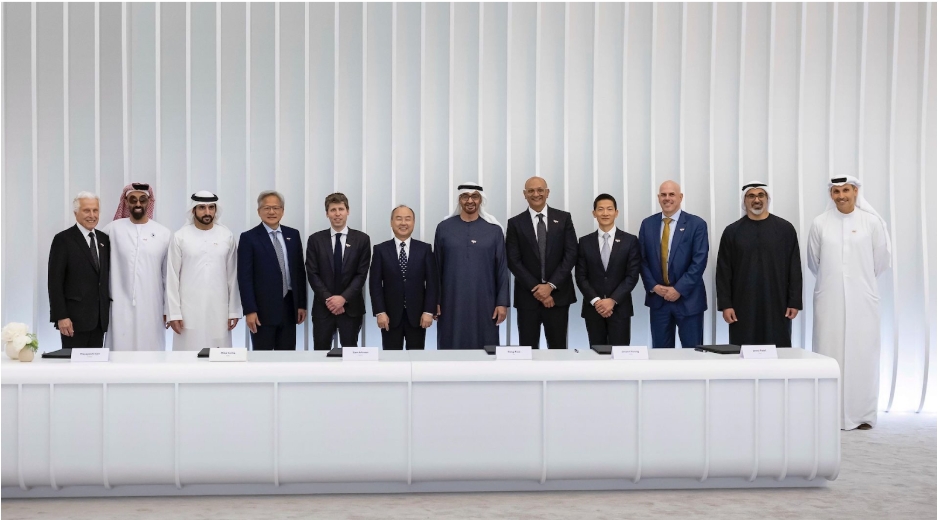
In May 2025, G42, OpenAI, Oracle, NVIDIA, SoftBank Group, and Cisco announce partnership to build Stargate UAE
This is reflected in their national AI strategies.
- In 2025, the United States released its 2025 AI Action Plan to accelerate AI innovation by cutting regulatory barriers, expanding compute and data center capacity, modernizing energy and power infrastructure, boosting semiconductor manufacturing, and promoting U.S. AI technologies and standards globally. Consistent with the plan, and U.S.-Saudi and U.S.-UAE partnership agreements on AI, the United States granted both Saudi Arabia and the UAE access to the equivalent of up to 35,000 of NVIDIA’s most advanced Blackwell chips and launched Pax Silica in December 2025 alongside trusted partners.
- In 2024, the UAE launched MGX, a partnership with Blackrock, Microsoft, and Global Infrastructure Partners to mobilize up to $100 billion for data centers and energy infrastructure. Microsoft invested $1.5 billion in the UAE’s national AI champion, Group 42, in April 2024, to bring Azure AI to the Middle East. The UAE is now developing its “Stargate” project, a massive data center cluster initiative backed by OpenAI and NVIDIA to build a 5-gigawatt AI supercomputer campus. The UAE has also made great strides in its Falcon large language model, one of the world’s top open-source platforms, and continues to invest in the development of data centers and energy across the globe.
- Saudi Arabia has leveraged its nearly $1 trillion Public Investment Fund to position itself as a global AI leader, launching HUMAIN, its national AI company in mid-2025, which has secured $1.2 billion for AI and digital infrastructure. Concurrently, it has started development of a 2-gigawatt AI supercluster with ambitions to scale to 6.6 gigawatts by 2034 to train sovereign AI models. It entered into a $10 billion partnership with Google to build a global AI hub and seeks to launch a $40 billion AI investment fund with venture capital firms to accelerate economic transformation under Vision 2030, facilitate global partnerships, support domestic startups, and build a world-class AI workforce.
- In 2025, building on its unique start-up culture and venture capital ecosystem, Israel launched a national AI and data infrastructure strategy, which includes significant public-private investments to build large-scale compute and data resources for AI. As part of this effort, the government selected Nebius to build and operate a national AI supercomputer to make advanced computing and GPUs affordable for startups, researchers, and public institutions. Nebius also deployed one of Israel’s first large-scale AI optimized data centers featuring thousands of NVIDIA Blackwell GPUs and signed a lease for a 80 megawatt data center for expanding AI computing infrastructure across the country and positioning it as a growing hub for data, cloud, and AI infrastructure.
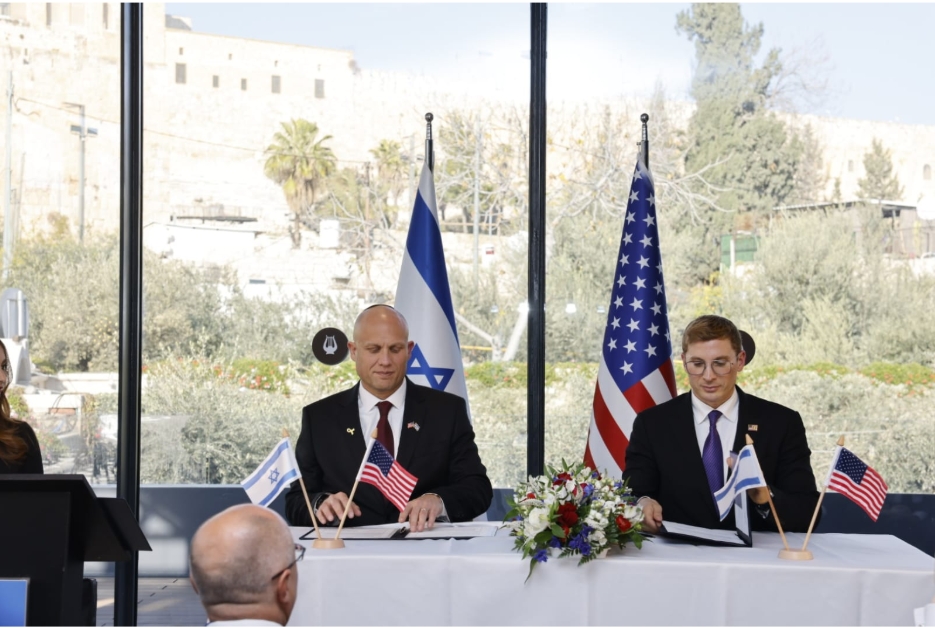
United States and Israel sign a joint statement launching a new strategic partnership in AI
The question now is how to translate first-mover advantage into sustained AI supremacy.
In December 2025, the United States launched Pax Silica alongside the United Kingdom, the Netherlands, Israel, Japan, South Korea, Singapore, Australia, Greece, Qatar, and the UAE. Canada, the European Union, the Netherlands, the Organization for Economic Cooperation and Development, and Taiwan are non-signatory participants. India, which will host an AI Summit this February in New Delhi, is expected to join soon. The U.S.-led initiative seeks to strengthen trusted supply chains for advanced technologies — from semiconductors and compute infrastructure to AI systems and critical minerals. The pact is meant to foster more resilient, interoperable technology ecosystems among U.S. allies, including Israel, Qatar, and the United Arab Emirates. By emphasizing interoperability, security, and alignment among partners, Pax Silica reflects a growing recognition that access to advanced computing capacity is a core element of national power and strategic resilience.
Pax Silica makes one thing clear: partnerships will be essential to winning the AI race. The fact that Israel and Qatar both signed on, despite long-held Israeli skepticism of Doha, signals that Middle East governments recognize large-scale computing infrastructure as more than just a commercial asset, but also a source of continuity and leverage. This creates a rare opening for strong and lasting partnerships with the United States and its closest allies.
This becomes especially true in the quantum domain. Beyond AI, quantum computing and quantum-enabled technologies are emerging as a powerful area for regional and transregional cooperation. Quantum systems are expected to reshape and revolutionize fields ranging from drug discovery and materials science to logistics optimization and advanced AI training. Although no single country dominates this space, Israel’s technical edge could be significantly amplified with deeper regional partnerships and collaboration. The United States recognizes Israel’s potential, signing an MOU with Israel on energy and artificial intelligence in 2025. Reportedly, the United States and Israel reached a deal this month to build an AI park and nuclear facility in southern Israel to power strategic chip manufacturing and AI development.
Potential cooperation between the United States, Israel, the United Arab Emirates, and Kazakhstan through the Abraham Accords could supercharge the region’s progress. A combination of Israeli research institutions, Emirati talent, capital and infrastructure, and U.S. leadership in AI could be accelerated by Kazakhstan’s role in supply chains in critical rare earth minerals and growing interest in high-tech research partnerships. Such a partnership could accelerate progress while reinforcing secure and transparent technology ecosystems, and include Morocco, Egypt, and Jordan, who are taking steps to sharpen their focus on AI.
It is within this broader context that the N7 Foundation and Nevo Labs convened a summit on January 20, 2026, titled Shaping the Future: Innovation and AI in the New Middle East. This gathering in New York brought together more than 100 policymakers, applied scientists, defense and security experts, research institutions, and investors from across the United States and the Middle East — including representatives from Israel, the UAE, Jordan, Singapore, Kazakhstan, and beyond — with the shared goal of advancing cooperation in AI and emerging technology.